Non-Surgical Facelift in Dubai: Treatments, Cost, Benefits and Risks
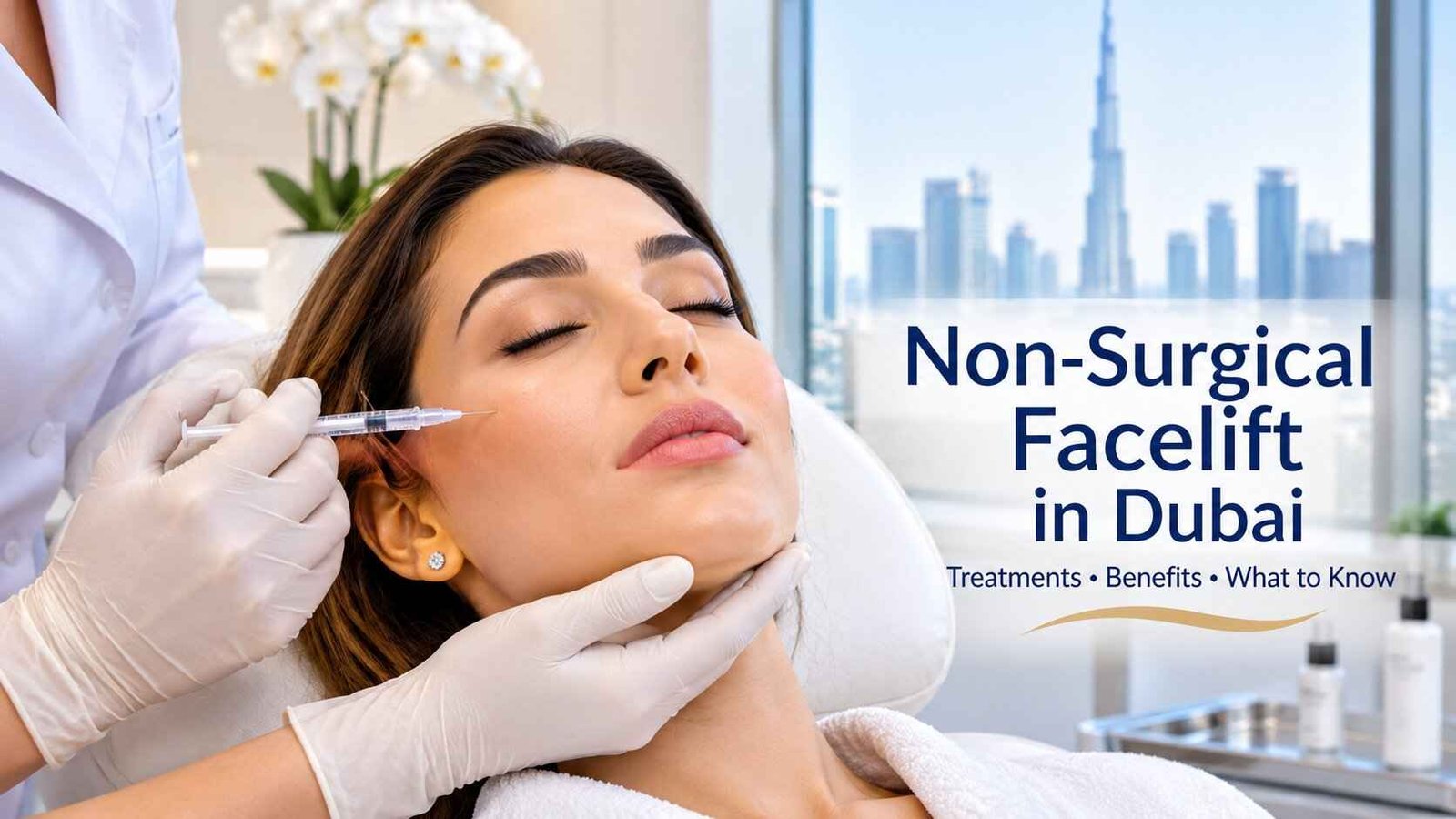
The appearance of facial ageing can change gradually. Fine lines may become more noticeable, cheeks can lose volume, the jawline may look less defined, and the skin may begin to appear loose around the lower face and neck. For people who want to address these changes without undergoing an operation, a non-surgical facelift in Dubai may be an option worth exploring.
Non-surgical facial rejuvenation includes several treatments designed to improve skin texture, restore selected areas of facial volume, soften wrinkles or make the skin appear firmer. Depending on the treatment, a clinic may use injectable products, energy-based devices, threads or other minimally invasive techniques.
However, the term non-surgical facelift does not describe one standard procedure. Different treatments address different concerns, and none should automatically be expected to produce the same results as a surgical facelift. Understanding the available options, costs, recovery requirements and possible complications can help patients make informed decisions.
Important health disclaimer: UAEHealthInfo.com is an independent informational platform, not a medical provider. This article is for general education and does not replace an individual consultation with a qualified doctor. Dubai residents can review the Dubai Health Authority’s official standards for non-surgical cosmetic procedures before choosing a treatment.
Quick Facts: Non-Surgical Facelift in Dubai
| Information | Details |
|---|---|
| Treatment category | Non-surgical facial rejuvenation |
| Main purpose | Address selected signs of facial ageing |
| Common options | Dermal fillers, Botox, thread lifts, radiofrequency and ultrasound-based treatments |
| Treatment area | Face, jawline, cheeks, forehead and selected neck areas |
| Suitable candidates | Depends on skin condition, facial anatomy and medical assessment |
| Recovery | Varies from minimal downtime to several days or longer |
| Results | Temporary or gradual, depending on the treatment |
| Cost in Dubai | Depends on procedure, product, device, clinic and treatment areas |
| Consultation | Assessment by an appropriately licensed medical professional |
| Important consideration | Results are not equivalent to surgical facelift results |
What Is a Non-Surgical Facelift?
A non-surgical facelift is a general term used for cosmetic treatments that aim to improve selected signs of facial ageing without conventional facelift surgery.
Rather than surgically removing excess skin or repositioning deeper facial tissues, these treatments may work by:
- Restoring lost facial volume.
- Relaxing selected muscles that contribute to expression lines.
- Improving the appearance of skin firmness.
- Supporting collagen production.
- Improving skin texture and surface appearance.
- Providing temporary lifting or contouring effects.
A treatment plan may involve one procedure or a combination of different approaches. For example, a doctor might recommend addressing volume loss in the cheeks separately from fine lines around the eyes.
The right approach depends on the patient’s facial structure, skin quality, expectations and medical history. A consultation is necessary to determine whether a non-surgical option is appropriate.
Popular Non-Surgical Facelift Treatments in Dubai
Dubai clinics may offer several facial rejuvenation procedures under the non-surgical facelift category. The exact treatments available vary by facility and practitioner.
1. Dermal Fillers
Dermal fillers are injectable products used to restore or add volume in selected facial areas. Certain fillers can help improve the appearance of volume loss in the cheeks, temples, chin or jawline.
Hyaluronic acid fillers are commonly used in aesthetic medicine. Depending on the product and treatment area, they can provide temporary changes in facial contour and fullness.
Potential uses include:
- Improving the appearance of hollow cheeks.
- Restoring selected areas of facial volume.
- Enhancing chin or jawline definition.
- Softening certain facial folds.
- Improving facial proportions.
Fillers do not physically remove loose skin. They may improve facial contours in suitable patients, but excessive or poorly placed filler can create an unnatural appearance.
The treatment should be performed by an appropriately qualified and licensed professional using an approved product suitable for the intended area.
2. Botox and Other Botulinum Toxin Treatments
Botulinum toxin injections are used to temporarily reduce the activity of selected facial muscles. They are commonly considered for expression lines that become visible when a person smiles, frowns or raises their eyebrows.
Areas that may be assessed include:
- Forehead lines.
- Lines between the eyebrows.
- Crow’s feet around the eyes.
- Selected lower-face areas, where clinically appropriate.
Botulinum toxin is not a skin-tightening treatment and does not restore lost facial volume. Its purpose is different from that of dermal fillers.
Results develop over several days rather than immediately, and the effects gradually wear off. The doctor should assess facial movement and explain which areas can reasonably be treated.
3. Thread Lift
A thread lift is a minimally invasive procedure in which temporary threads are placed under the skin to provide a degree of mechanical support or lifting.
Depending on the technique, threads may be used to address selected areas around the cheeks, jawline or lower face.
A thread lift is not the same as a surgical facelift. The amount of lifting is generally more limited, and results depend on skin condition, facial anatomy, technique and the type of threads used.
Patients should discuss:
- The doctor’s experience with the specific technique.
- The type of thread being used.
- Expected results and limitations.
- Possible bruising, swelling and discomfort.
- Infection, thread visibility, asymmetry or other complications.
- Recovery instructions and follow-up arrangements.
It is important to understand that a thread lift is still an invasive procedure involving the placement of material under the skin. It should not be treated as a simple beauty service.
4. Radiofrequency Skin Tightening
Radiofrequency treatments use controlled energy to heat targeted skin tissues. Depending on the device and treatment method, this may encourage changes associated with collagen remodelling and improve the appearance of mild skin laxity.
Some systems use external applicators, while others involve microneedles that deliver radiofrequency energy into the skin.
Potential treatment areas include the cheeks, jawline, lower face and selected neck areas.
Results are not immediate in every case. Some patients may need multiple sessions, and the degree of improvement varies.
Ask the practitioner which device is being used, whether it is appropriate for your skin type and what side effects or downtime to expect.
5. High-Intensity Focused Ultrasound (HIFU)
High-intensity focused ultrasound, commonly called HIFU, is an energy-based treatment used in selected skin-tightening applications.
The device delivers focused ultrasound energy to targeted tissue layers. The aim is to encourage a biological response that may gradually improve the appearance of skin firmness.
HIFU is sometimes marketed for:
- Mild lower-face laxity.
- Jawline appearance.
- Selected cheek areas.
- Certain neck concerns.
It is not suitable for every patient, and results depend on the device, treatment settings, anatomy and degree of skin laxity.
A medical assessment should establish whether the treatment is appropriate and whether another approach would be more suitable.
6. Laser Skin Rejuvenation
Laser treatments are used for different skin concerns, including uneven pigmentation, selected scars, fine lines and skin texture.
Different laser systems work in different ways. Some target pigmentation, while others are designed to resurface the skin or stimulate collagen-related changes.
Laser rejuvenation may be included in a wider facial treatment plan, but it does not necessarily create a lifting effect.
Patients should discuss skin type, pigmentation risk, sun exposure, previous treatments and recovery requirements before choosing a laser procedure.
7. Platelet-Rich Plasma (PRP)
Platelet-rich plasma, or PRP, is prepared using a sample of the patient’s own blood. The blood is processed to concentrate platelets, and the resulting preparation is used in selected medical and aesthetic procedures.
PRP is sometimes offered for facial skin rejuvenation. However, it should not be confused with a traditional facelift or a proven method of lifting significantly loose skin.
Patients should ask what improvement is realistically expected, how many sessions may be recommended and what evidence supports the proposed treatment.
Non-Surgical Facelift vs Surgical Facelift
The main difference is that non-surgical treatments aim to improve selected facial concerns without conventional facelift surgery, while surgical procedures can reposition deeper tissues and remove excess skin.
| Feature | Non-surgical facelift | Surgical facelift |
|---|---|---|
| Procedure | Injections, devices or other minimally invasive techniques | Operation involving surgical incisions |
| Anaesthesia | Depends on the treatment | Depends on the surgical plan |
| Skin removal | Generally no | May involve removal of excess skin |
| Tissue repositioning | Limited or treatment-specific | Can reposition deeper facial tissues |
| Recovery | Varies by procedure | Usually involves a longer recovery |
| Results | Often temporary or gradual | Generally longer-lasting, but ageing continues |
| Best suited to | Selected concerns and appropriate candidates | Patients requiring more substantial correction |
Neither approach is automatically right for everyone. A patient with significant loose skin may not achieve the desired result through injections or energy-based treatments alone.
Who May Be Suitable for a Non-Surgical Facelift?
Suitability depends on the individual’s medical history, facial anatomy, skin condition and expectations.
A doctor may consider non-surgical facial rejuvenation for someone who:
- Has mild facial skin laxity.
- Notices volume loss in selected facial areas.
- Wants to address certain expression lines.
- Has specific concerns about skin texture.
- Prefers to explore options without conventional surgery.
- Understands that results may be limited or temporary.
A person with substantial excess skin or advanced facial ageing may need to discuss surgical options instead.
Some medical conditions, allergies, active skin infections, pregnancy-related considerations or previous cosmetic procedures may affect treatment suitability. Always disclose your full medical history and previous aesthetic treatments during the consultation.
Benefits and Limitations
Non-surgical facial treatments can offer advantages for selected patients, but they also have limitations.
Potential benefits
- Some procedures can be completed during an outpatient appointment.
- Certain treatments require little downtime.
- Different techniques can address different facial concerns.
- Some treatments provide gradual improvements.
- Patients may be able to avoid conventional surgery.
Important limitations
- Results are not the same as a surgical facelift.
- Many treatments are temporary.
- More than one session may be required.
- Some procedures can cause bruising, swelling or discomfort.
- Complications can occur, including serious complications.
- Costs can increase when several procedures are combined.
A clinic should explain both the expected benefits and the limitations before treatment begins.
Non-Surgical Facelift Cost in Dubai
The cost of a non-surgical facelift in Dubai varies because the term covers several different procedures. A patient considering Botox may receive a very different quotation from someone considering fillers, a thread lift or an energy-based skin-tightening treatment.
There is no single reliable price for every non-surgical facelift.
The final quotation may depend on:
| Cost factor | Why it matters |
|---|---|
| Treatment type | Different procedures require different products, equipment and expertise |
| Number of areas | Treating several facial areas may increase the total cost |
| Product quantity | Injectable treatments may be priced according to the product or amount used |
| Device and technology | Equipment and treatment protocols vary |
| Doctor’s qualifications | Specialist experience and clinical expertise may influence fees |
| Number of sessions | Some treatments require a course of sessions |
| Follow-up care | Review appointments or additional treatment may affect the total |
Before booking, ask the clinic for an itemised quotation. Confirm whether the price includes the consultation, product, procedure, follow-up appointment and any additional charges.
Do not choose a treatment solely because a clinic advertises a low price. The qualifications of the practitioner, the product or device used and the clinic’s ability to manage complications are important considerations.
What Happens During a Consultation?
A proper consultation should involve more than selecting a treatment from a price list.
The practitioner should discuss your concerns, examine the relevant facial areas and review your medical history. They should also explain the available options and whether the proposed treatment is suitable.
A typical consultation may include:
- Discussion of concerns: Explain what you would like to improve, such as wrinkles, volume loss or mild skin laxity.
- Medical history: Discuss allergies, medication, previous cosmetic treatments and relevant health conditions.
- Facial assessment: The practitioner examines skin quality, facial structure and the areas you want to address.
- Treatment recommendation: You should receive an explanation of suitable options and their limitations.
- Risk discussion: Ask about common side effects, serious complications and how emergencies are managed.
- Cost estimate: Request a clear quotation and understand any additional fees.
- Informed consent: Take time to understand the procedure before agreeing to treatment.
You should never feel pressured to make an immediate decision.
Risks and Possible Side Effects
Non-surgical does not mean risk-free. Every cosmetic procedure has potential side effects, and the type and severity depend on the technique, product, treatment area and practitioner.
Possible side effects include:
- Temporary redness.
- Swelling.
- Bruising.
- Tenderness or discomfort.
- Infection.
- Uneven results.
- Skin irritation.
- Allergic reactions.
- Lumps or nodules.
- Changes in skin sensation.
Some injectable procedures have rare but serious risks. The US Food and Drug Administration warns that accidental injection of dermal filler into a blood vessel can cause tissue death, vision abnormalities including blindness, or stroke. These complications require urgent medical attention. Read the FDA’s official dermal filler safety information.
Seek urgent medical attention if you develop sudden vision changes, severe or unusual pain, skin colour changes, weakness, difficulty speaking or other concerning symptoms after a cosmetic procedure.
How to Choose a Clinic for a Non-Surgical Facelift in Dubai
Dubai has many aesthetic clinics offering facial rejuvenation services. Comparing facilities carefully is important because the treatment outcome and safety depend on more than the advertised procedure.
Consider the following points before booking.
Check the Clinic’s Licence
Confirm that the healthcare facility is properly licensed by the relevant authority. For facilities operating under DHA jurisdiction, use the official DHA website and its healthcare facility information.
Verify the Practitioner’s Qualifications
Ask who will perform the procedure and whether that professional is licensed and authorised to provide the specific treatment.
Do not assume that every person working at an aesthetic clinic is qualified to perform injectable or invasive procedures.
Ask About the Product or Device
If the treatment involves injections, ask for the product name, manufacturer, packaging information and relevant approval status. If a device is being used, ask for its name and the reason it is suitable for your concern.
Discuss Complication Management
Ask what happens if you experience an adverse reaction. The clinic should be able to explain its follow-up arrangements and how it manages complications.
Review Before-and-After Images Carefully
Photographs can help you understand a practitioner’s work, but results vary between individuals. Ask whether the photographs show actual patients treated by the practitioner and whether lighting, camera angle and timing are comparable.
Avoid Pressure-Based Offers
Be cautious about promotions that encourage you to purchase multiple procedures without a proper assessment. A responsible practitioner should explain why a treatment is being recommended and whether it is necessary.
DHA Rules for Non-Surgical Cosmetic Procedures in Dubai
Patients should understand that non-surgical cosmetic procedures in Dubai are subject to healthcare regulations.
The Dubai Health Authority published Standards for Non-Surgical Cosmetic Procedures, Version 2.1, with an effective date of 18 February 2025. The DHA also issued a 2025 reminder about the updated standards.
One important update states that only licensed plastic surgeons are authorised to perform invasive skin procedures involving skin opening for skin tightening, lifting or fat-dissolving procedures on the face and body. The standards also address professional scope of practice and other cosmetic procedures.
This is particularly relevant when a clinic advertises a treatment as non-surgical but the technique involves opening or penetrating the skin.
Patients should not rely only on a clinic’s marketing description. Ask which professional will perform the treatment and confirm that the professional is authorised to carry out that specific procedure.
Official references:
- DHA Standards for Non-Surgical Cosmetic Procedures, Version 2.1
- DHA circular: Updated Standards for Non-Surgical Cosmetic Procedures
- DHA healthcare professional and facility information
How Long Do Non-Surgical Facelift Results Last?
There is no universal duration because different treatments work in different ways.
For example, botulinum toxin effects gradually wear off, while the duration of dermal filler results depends on the product, injection area and individual factors. Thread lifts and energy-based procedures also have different treatment outcomes and maintenance requirements.
Results may be affected by:
- The type of procedure.
- The product or device used.
- The treatment area.
- Skin condition and facial anatomy.
- Individual response to treatment.
- Lifestyle and ongoing ageing.
Ask the practitioner for a realistic estimate based on the exact treatment being proposed. Be cautious about promises of permanent results from temporary or minimally invasive procedures.
Frequently Asked Questions
1. What is the best non-surgical facelift treatment in Dubai?
There is no single best treatment for everyone. Fillers may address selected volume-loss concerns, botulinum toxin may soften expression lines, and certain energy-based treatments may improve the appearance of mild skin laxity. The appropriate option depends on an individual medical assessment.
2. How much does a non-surgical facelift cost in Dubai?
The price depends on the treatment, number of areas, products, equipment, practitioner and number of sessions. Ask the clinic for an itemised quotation rather than relying on a general advertised price.
3. Is a non-surgical facelift painful?
Discomfort varies. Some treatments involve mild temporary discomfort, while injections and thread lifts may cause tenderness or bruising. The practitioner should explain what to expect and whether any pain-control measures are appropriate.
4. How long does a non-surgical facelift take?
Treatment time depends on the procedure and number of areas being addressed. A simple injectable appointment may be relatively short, while some device-based treatments or combined plans take longer.
5. Can a non-surgical facelift remove sagging skin?
Non-surgical treatments may improve the appearance of mild skin laxity in selected patients. They generally cannot remove significant excess skin or reproduce the lifting effect of a surgical facelift.
6. Is a thread lift considered non-surgical?
A thread lift is generally described as minimally invasive rather than completely non-invasive. Threads are placed beneath the skin, so patients should discuss the risks, qualifications required and recovery process with an appropriately authorised practitioner.
7. Are dermal fillers safe?
Dermal fillers can cause temporary side effects and, rarely, serious complications. Accidental injection into a blood vessel can lead to tissue damage, blindness or stroke. Treatment should only be considered after an appropriate assessment by a qualified professional.
8. Can Botox lift the face?
Botulinum toxin relaxes selected muscles and can change the appearance of certain facial lines. It does not remove excess skin or provide the same mechanical lifting effect as surgery.
9. How many sessions are needed?
The number of sessions depends on the treatment. Some procedures are performed in one appointment, while others may require several sessions or maintenance treatments.
10. Can I return to normal activities after treatment?
That depends on the procedure. Some treatments have little downtime, while others may require temporary restrictions on exercise, sun exposure, makeup or certain activities. Follow the instructions given by your practitioner.
11. Is a non-surgical facelift suitable for older adults?
Age alone does not determine suitability. Skin condition, general health, facial anatomy, medication and treatment expectations are all relevant. A doctor should assess whether the expected benefit justifies the risks.
12. Does Dubai regulate non-surgical cosmetic procedures?
Yes. The Dubai Health Authority publishes standards governing non-surgical cosmetic procedures and the professionals authorised to perform them. Patients should verify the clinic’s licence and the practitioner’s scope of practice before treatment.
Conclusion
A non-surgical facelift in Dubai can involve several different approaches, from dermal fillers and botulinum toxin to thread lifts, radiofrequency and ultrasound-based skin treatments. Each option addresses different concerns, and the expected results, recovery time, cost and risks vary.
The most important step is to identify what you want to improve and obtain an individual assessment from an appropriately licensed medical professional. Check the clinic’s credentials, understand the treatment being offered, ask about possible complications and avoid making decisions based only on promotional prices or dramatic before-and-after photographs.
Non-surgical treatments may offer meaningful improvements for selected patients, but they are not a substitute for surgery when substantial skin removal or deeper tissue repositioning is needed. An informed decision should always prioritise safety, realistic expectations and qualified medical care.