
Non-Surgical Rhinoplasty in Dubai: Procedure, Benefits, Risks and What to Know
A small bump on the bridge of the nose, a slightly uneven profile, or a tip that does not look quite as defined as you would like can make people consider rhinoplasty. But not everyone wants surgery, anesthesia, incisions, or a long recovery period.
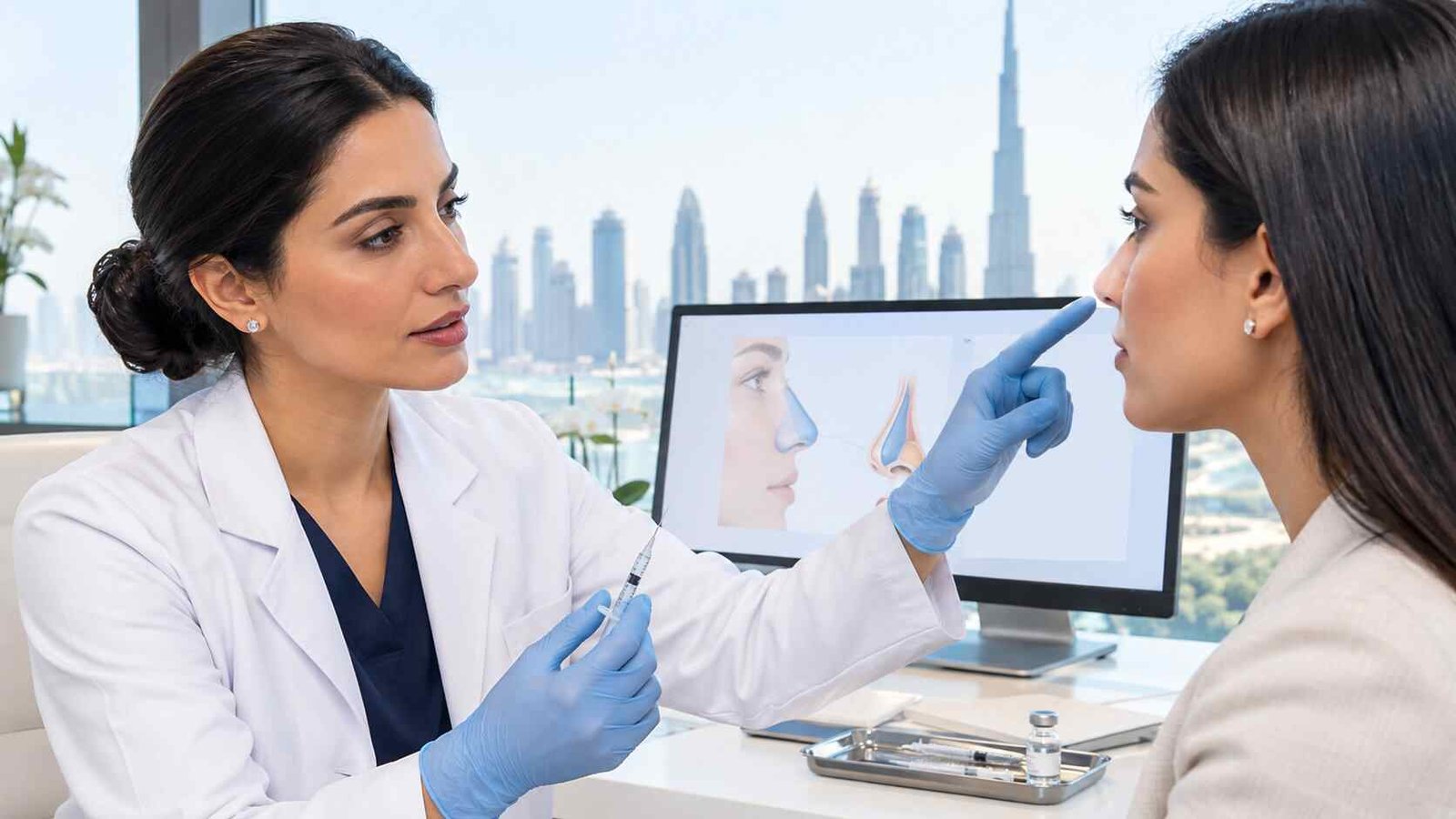
That is where non-surgical rhinoplasty in Dubai comes in. Also called a liquid rhinoplasty or non-surgical nose job, the procedure uses injectable dermal filler to temporarily change the appearance of the nose.
The important word is temporarily. Unlike surgical rhinoplasty, filler does not remove bone, cartilage, or tissue. It adds carefully controlled volume to selected areas to create the appearance of a smoother or more balanced nose. It can therefore address some cosmetic concerns, but it cannot perform every change that surgery can.
There is also an important safety consideration. The nose has a complex blood supply and is close to the eyes. Accidental injection of filler into a blood vessel can cause serious complications, including tissue damage and, rarely, vision loss or stroke. For this reason, choosing a properly qualified medical professional is much more important than simply finding the lowest treatment price.
Disclaimer: UAEHealthInfo.com is an informational platform providing general health and medical education for readers in the UAE. The information in this article is not a substitute for diagnosis, treatment, or personalized medical advice from a qualified healthcare professional. Non-surgical rhinoplasty involves dermal fillers and carries potential risks, including rare but serious complications, so readers should discuss suitability and safety with a licensed medical professional. For additional information about dermal filler safety and risks, refer to the official U.S. Food & Drug Administration (FDA) dermal filler guidance.
What Is Non-Surgical Rhinoplasty?
Non-surgical rhinoplasty is a cosmetic procedure in which a healthcare professional injects dermal filler into specific areas of the nose to alter its contour.
Most liquid rhinoplasty procedures use a temporary filler, commonly a hyaluronic-acid-based product. The filler adds volume beneath the skin, allowing the practitioner to smooth or camouflage certain irregularities.
For example, adding a small amount of filler around a nasal bump can sometimes create a straighter-looking profile. Similarly, carefully placed filler may improve the appearance of a less-defined nasal tip or create greater visual symmetry.
The procedure does not physically reshape the underlying nasal bones or cartilage.
This distinction is essential when considering non-surgical rhinoplasty in Dubai. A treatment that adds volume cannot literally remove a hump or make a large nose smaller.
What Can Non-Surgical Rhinoplasty Change?
Liquid rhinoplasty is generally intended for relatively subtle cosmetic adjustments.
Depending on the person’s nasal anatomy and the practitioner’s assessment, filler may be used to:
- Smooth the appearance of a dorsal bump
- Improve the appearance of minor contour irregularities
- Create a more continuous-looking nasal bridge
- Add definition to selected areas of the nasal tip
- Improve the visual appearance of mild asymmetry
- Create the appearance of a straighter nasal profile
- Improve overall facial balance
The exact result depends on the starting anatomy, filler product, injection technique, and amount used.
A consultation is therefore more useful than judging suitability from photographs alone.
Can a Liquid Rhinoplasty Make the Nose Smaller?
No.
This is one of the most important limitations to understand before treatment.
Dermal filler adds volume. It cannot remove tissue or reduce the size of the nasal bones or cartilage. In some cases, adding volume in strategic locations can make the nose look more balanced or straighter, which may give the impression of a refined shape.
But if your primary goal is to make your nose physically smaller, narrower, or structurally different, surgical rhinoplasty may need to be discussed with a qualified specialist.
Cleveland Clinic similarly notes that nonsurgical rhinoplasty cannot make the nose smaller or narrower, although filler can temporarily camouflage bumps and alter certain contours.
How Does Non-Surgical Rhinoplasty in Dubai Work?
The process normally starts with a consultation rather than immediately injecting filler.
The practitioner should examine your nose, discuss what you want to change, consider your medical history, and determine whether filler is appropriate for your anatomy and goals.
Photographs may also be taken during the assessment so that the practitioner can evaluate the shape of the nose and plan treatment.
If you are considered an appropriate candidate, the treatment area may be prepared with an anesthetic or another method to improve comfort. The filler is then placed in carefully selected areas.
The procedure itself can be relatively quick, but the speed of treatment should never be used as a reason to rush the decision.
A technically simple-looking injection can still involve significant anatomical considerations.
How Long Does the Procedure Take?
The appointment can often be completed within a relatively short period, although the total time varies according to the consultation, treatment plan, preparation, and individual circumstances.
Cleveland Clinic states that nonsurgical rhinoplasty typically takes less than an hour.
The more important question is not how quickly the injection can be completed, but whether the practitioner has properly assessed the nose and has a clear plan for managing complications if they occur.
Is Non-Surgical Rhinoplasty Painful?
Most people experience some pressure, pinching, or discomfort during an injection.
The level of discomfort varies according to the individual and the treatment technique. A topical anesthetic may sometimes be used.
After treatment, temporary tenderness, redness, swelling, or bruising can occur. These effects generally improve as the treated area settles.
If pain becomes severe or unusual rather than gradually improving, it should not simply be dismissed as normal recovery.
What Are the Benefits of Non-Surgical Rhinoplasty?
The appeal of liquid rhinoplasty is mainly related to the limited nature of the procedure.
Compared with surgical rhinoplasty, it generally involves no surgical incision and does not require the same type of recovery associated with an operation.
Potential advantages include:
- No surgical incision
- Relatively short treatment time
- Little or no conventional surgical downtime
- Immediate change in contour
- Temporary results
- Ability to make relatively subtle cosmetic adjustments
- No removal of nasal bone or cartilage
For someone who wants a modest contour change rather than a major structural transformation, these characteristics may make a filler-based approach worth discussing with a qualified medical professional.
However, these advantages should not be confused with an absence of risk.
How Long Do Results Last?
Non-surgical rhinoplasty is temporary.
The duration depends on the filler material, the treatment area, the amount injected, and individual factors affecting how the body processes the product.
Cleveland Clinic reports that results typically last up to about six months, while the American Society of Plastic Surgeons notes that results can vary and may last approximately six months to one year depending on the product and individual factors.
Because results are temporary, maintaining the appearance may require future treatments.
This is also why you should consider the long-term cost, rather than comparing only the price of one appointment with the price of surgical rhinoplasty.
What Are the Risks of Non-Surgical Rhinoplasty?
This is the section prospective patients should take seriously.
Dermal fillers commonly cause temporary effects such as swelling, redness, bruising, tenderness, itching, or pain. Less common complications include infection, nodules, inflammatory reactions, allergic reactions, and filler migration.
The more serious concern is accidental injection into a blood vessel.
If filler enters a blood vessel, it can obstruct blood flow. Depending on the affected vessel, this can result in tissue necrosis, visual abnormalities, blindness, or stroke. The FDA identifies unintended injection into blood vessels as the most concerning risk associated with dermal fillers.
The nasal region deserves particular caution because of its vascular anatomy and proximity to the eyes. Professional plastic surgery guidance also identifies the nose as a higher-risk area for filler-related vascular complications.
This does not mean serious complications are inevitable. It means the procedure should be treated as a medical procedure, not as an ordinary beauty treatment.
Safety Note: When Should You Seek Immediate Medical Help?
After a filler procedure, contact your healthcare provider urgently if you experience symptoms that could indicate a serious complication.
Particularly concerning signs include:
- Sudden or unusual severe pain
- Skin becoming white, grey, or blue near the injection area
- Sudden changes in vision
- Significant or rapidly worsening swelling
- Signs of infection
- Sudden weakness or numbness
- Difficulty speaking
- Facial drooping
- Severe headache, dizziness, or confusion
The FDA advises patients to seek immediate medical attention for unusual pain, changes in vision, abnormal skin color near the injection site, or symptoms suggestive of stroke after dermal filler injection.
Do not wait for symptoms to disappear on their own if a serious complication is suspected.
Who Should Perform Non-Surgical Rhinoplasty in Dubai?
The qualifications and experience of the practitioner should be among your first questions.
Because the nose contains important blood vessels and is close to the eyes, filler injection requires a strong understanding of facial anatomy and appropriate emergency management.
Before booking treatment, ask:
- What medical qualification does the practitioner have?
- How much experience do they have with nasal filler?
- What dermal filler product will be used?
- Can they show you the sealed product packaging?
- What are the known risks?
- What happens if a vascular complication occurs?
- What aftercare will you receive?
- Who should you contact if you develop a problem after leaving the clinic?
The FDA advises that dermal fillers should be administered by appropriately trained healthcare professionals and stresses the importance of understanding facial anatomy and having a plan for managing vascular complications.
In Dubai, patients should also verify that the healthcare professional and facility are appropriately licensed for the service being provided.
What Should You Ask During Your Consultation?
A good consultation should be a discussion rather than a sales presentation.
Tell the practitioner exactly what bothers you about your nose. Instead of simply saying that you want a “better nose,” explain whether your concern is a bump, asymmetry, bridge contour, tip definition, or another specific feature.
Then ask what filler can realistically accomplish.
Useful questions include:
- What can filler improve in my particular nose?
- What can it not change?
- Would filler make my nose appear larger?
- What type of filler are you proposing?
- Is the product temporary or permanent?
- What complications should I understand before treatment?
- What is your emergency protocol for vascular complications?
- What should I expect during the first few days?
- How long might the result last?
- What would be the alternative if filler is not appropriate?
A practitioner who explains limitations clearly is giving you more useful information than someone who focuses only on the expected cosmetic result.
Non-Surgical Rhinoplasty vs Surgical Rhinoplasty
The two procedures solve different problems.
| Feature | Non-Surgical Rhinoplasty | Surgical Rhinoplasty |
|---|---|---|
| Main approach | Dermal filler | Surgery |
| Incisions | No | Yes, depending on technique |
| Changes bone/cartilage | No | Yes |
| Can make nose smaller | No | Yes |
| Results | Temporary | Long-lasting/permanent structural change |
| Recovery | Generally limited | Longer surgical recovery |
| Best suited to | Selected contour adjustments | Structural or significant changes |
This comparison does not mean one procedure is appropriate for everyone.
If your concern is primarily a minor contour irregularity, a qualified practitioner may discuss filler as one option. If you want significant structural changes, reduction in size, or improvement in nasal function, surgical assessment may be more appropriate.
The right approach depends on the anatomy of your nose and the outcome you want.
Can Non-Surgical Rhinoplasty Improve Breathing?
Cosmetic filler should not be viewed as a treatment for nasal breathing problems.
Nonsurgical rhinoplasty changes external appearance. It does not remove a deviated septum, reduce enlarged internal structures, or otherwise perform the structural corrections that may be required for functional nasal problems.
If your main concern is difficulty breathing through your nose, frequent nasal blockage, or another functional problem, tell the doctor during the consultation rather than approaching the procedure purely as a cosmetic treatment.
The distinction between cosmetic appearance and nasal function is important when deciding whether a liquid rhinoplasty is appropriate.
What About Aftercare?
Your practitioner should provide individualized aftercare instructions because recommendations can vary depending on the filler, injection technique, and your medical circumstances.
Immediately after treatment, mild swelling, redness, tenderness, or bruising may occur.
Do not assume that every unusual symptom is simply part of recovery. In particular, visual changes, severe pain, abnormal skin coloration, or neurological symptoms require urgent medical attention.
Following the specific instructions provided by your treating clinician is preferable to relying on generic aftercare advice from social media.
Is Non-Surgical Rhinoplasty Safe?
There is no cosmetic injection that can honestly be described as completely risk-free.
Nonsurgical rhinoplasty can produce useful temporary contour changes for appropriately selected patients, but nasal filler carries specific anatomical risks. The most serious complications are uncommon but potentially severe.
The safety of the procedure therefore depends on several factors, including appropriate patient selection, the product used, injection technique, practitioner training, sterile practice, and the ability to recognize and respond rapidly to complications.
A low price should not be the main deciding factor.
What Should You Check Before Booking in Dubai?
Dubai has a large aesthetic healthcare market, so patients can encounter many different clinics, practitioners, treatment packages, and advertised prices.
Before paying a deposit, check the medical side of the decision first.
Confirm:
- The facility is appropriately licensed.
- The person performing the injection is a qualified healthcare professional.
- The treatment is actually being performed by the person you were told would treat you.
- You know which filler will be injected.
- The product packaging and labeling can be verified.
- The practitioner has experience with nasal filler.
- You have received an explanation of risks and alternatives.
- You know what to do if you develop a complication after treatment.
- The quoted price clearly explains what is included.
Avoid purchasing dermal filler online and attempting to inject it yourself. The FDA specifically warns against self-injection and needle-free filler devices.
Frequently Asked Questions
Is non-surgical rhinoplasty permanent?
No. Dermal filler used for liquid rhinoplasty is generally temporary, and the duration varies according to the product and individual factors.
Can liquid rhinoplasty remove a nose bump?
It cannot remove the bump itself. Filler can sometimes be placed around a bump to camouflage the contour and create a straighter-looking profile.
Can non-surgical rhinoplasty make my nose smaller?
No. Filler adds volume rather than removing tissue. It may make the nose look more balanced, but it cannot physically reduce nasal size.
Is liquid rhinoplasty painful?
Some pressure, pinching, tenderness, or discomfort can occur. Temporary redness, swelling, and bruising are also possible.
How long does a non-surgical nose job take?
The treatment itself can be relatively quick, and Cleveland Clinic reports that it typically takes less than an hour.
Can filler in the nose cause blindness?
A serious vascular complication from facial filler can cause visual impairment or blindness. The risk is uncommon, but the potential severity is why nasal filler requires careful medical technique and appropriate emergency preparedness.
Is non-surgical rhinoplasty suitable for everyone?
No. Suitability depends on your nasal anatomy, cosmetic goals, medical history, previous procedures, and what you expect the treatment to accomplish.
Is non-surgical rhinoplasty better than surgical rhinoplasty?
They are not interchangeable treatments. Filler is temporary and can add volume or camouflage selected irregularities, while surgery can make structural changes that filler cannot. The appropriate option depends on the individual’s goals and anatomy.
Conclusion
If you are considering non-surgical rhinoplasty in Dubai, start with the change you actually want rather than the procedure you have seen advertised.
Liquid rhinoplasty can temporarily improve selected contours, camouflage certain bumps, and create a more balanced appearance without traditional nasal surgery. But it cannot make the nose physically smaller, remove bone or cartilage, or provide all the structural changes possible with surgical rhinoplasty.
Most importantly, nasal filler should not be treated as a routine beauty injection. The nose has important blood vessels and is close to the eyes, so serious vascular complications, although uncommon, can occur.
Before spending money, have a proper consultation with a qualified healthcare professional, ask what filler can realistically achieve in your case, understand the alternatives, and make sure you know how complications would be handled.
For a cosmetic decision involving your face, a realistic treatment plan and safety protocol matter more than an attractive before-and-after photograph or a discounted package.