
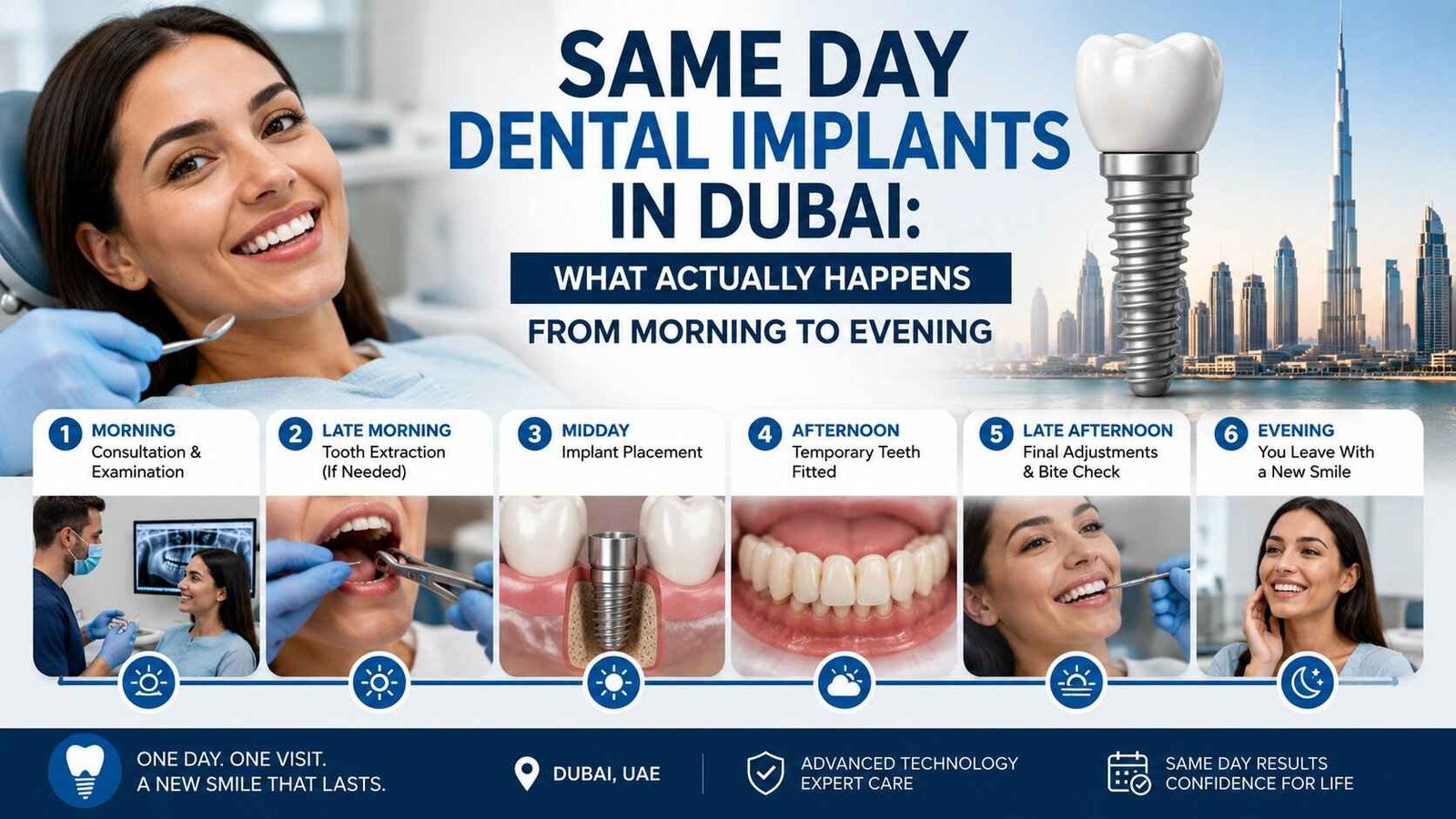
Same Day Dental Implants in Dubai: What Actually Happens From Morning to Evening
Introduction
The most frequently asked question from people who telephone about dental implants is a practical one: do they leave with a tooth on the same day, or do they leave with a gap?
It’s a reasonable question in Dubai, since it’s not easy to take an entire day off work, and no one wants to attend client meetings with a front tooth missing. Although same-day implant treatment is available and well-established, in reality, its meaning is less than what the advertising usually implies.
Here is the straightforward account, presented as a timeline from morning to evening.
Table of contents
- What “same day” actually covers
- Early morning: the assessment that decides the rest of the day
- Mid morning: planning the position before anything is placed
- Late morning: placing the tooth implant
- Early afternoon: the temporary tooth
- Evening: going home and getting through the first night
- Who this suits, and who is better off waiting
- What happens in the months after that one day
- Frequently asked questions
- Conclusion
- Contact us
What “same day” actually covers
What the term same day dental implants actually means is that when the implant is placed, a temporary tooth is attached at the same appointment, as opposed to allowing the area to heal for a few months first. This procedure is known as immediate loading.
The implant is a small titanium post which is placed in the jawbone in place of the tooth root. It takes time for the bone to grow tightly around the post, and no technique can speed up this biological process. What is different with same-day treatment is the waiting that you have to do in public; instead of leaving with a gap, you leave with something in the space.
The last crown, which is designed to match your other teeth in colour and shape, is put in place only after the healing process is complete. To say that the permanent tooth is finished by dinner is to be describing a different situation.
Early morning: the assessment that decides the rest of the day
They usually begin early, frequently at eight, since the day requires some space.
First of all, the dentist carries out a CBCT scan. This is a three-dimensional X-ray which shows the shape of your jawbone, how thick it is at that position, and the location of the nerve and sinus. A conventional flat X-ray is unable to display any of these features, and without the CBCT scan no one can truly state that same-day placement is possible for you.
Your medical history is just as important since uncontrolled diabetes, some bone treatments, heavy smoking and a current gum infection all have an effect on how bone responds; here, blood sugar control is a frequent topic of discussion, so if you have one, please bring your most recent HbA1c reading.
The aspect that patients usually do not anticipate comes next. If the scan indicates that the bone is too thin or too soft to securely hold the implant on the first day, the procedure is altered right then in the morning. This is the assessment carrying out its function, not a sign that the appointment has failed.
Mid morning: planning the position before anything is placed
When the scan has been completed, the site is then planned using a digital method. A small intraoral camera takes a scan of your mouth and creates a model without the need for impression trays, a process which most people find more comfortable to endure.
The dentist next chooses the precise angle and depth on the screen, comparing it with the image of the bone as seen in the CBCT and with the way your teeth come together when you bite. The position is no mere cosmetic consideration; if an implant is placed at the wrong angle, it will make the final crown more difficult to shape, more difficult to clean, and less comfortable to chew for years later.
Late morning: placing the tooth implant
If the damaged tooth is still in position, then it is first removed in a gentle manner with as much of the surrounding bone as possible being kept intact since it is this bone that will hold the new implant.
The region is numbed using a local anaesthetic; you remain awake and, generally, experience pressure and vibration instead of sharp pain. The dentist gradually opens up the area, then inserts the tooth implant and rotates it until it is securely in place.
The firmness in question is the key point of the entire day; it is only possible to fit a temporary tooth immediately with an implant that firmly holds itself in the bone. If the implant turns too easily, the right course of action is to close the site, allow it to heal for a few months and then fit the tooth later. A dentist who takes that approach is safeguarding your final result.
The process of placing a single tooth usually takes less than an hour.
Early afternoon: the temporary tooth
Once the implant has been put in, the next focus is on the crown you will wear when you get home. A temporary tooth is created and placed on the implant. It is shaped so as to appear natural and to keep the gum in the proper contour during the healing process, which in turn improves the appearance of the final crown later on. The bite is carefully adjusted, and this step lasts longer than most people anticipate. The temporary tooth is intentionally kept with only light contact so that the forces produced when chewing will not act on the healing implant. Although it resembles a natural tooth and helps to maintain your smile, it is not designed for biting into a lamb chop. The key thing that determines whether the implant settles smoothly is an understanding of this difference.
Usually by mid-afternoon the clinical work has been completed.
Evening: going home and getting through the first night
You’re left with a numb lip, some aftercare instructions, and generally a prescription.
It is normal to notice some swelling around the cheek, and this usually reaches its peak on the second or third day instead of the first; cold packs are helpful. For the first few days it is advisable to eat soft and cool food, and in Dubai this is made easy by the availability of labneh, soups, mashed rice dishes and yoghurt drinks.
On that first evening, two things are more important than everything else: do not chew on the side of the implant and keep the area clean without rubbing it. Rinsing generally begins the next day, not that same night.
Smoking is the problem in this case, and shisha is included. Both heat and suction have an effect on the early healing process.
Most patients return to work the following day, although those who had several implants put in usually prefer to take the day off.
Who this suits, and who is better off waiting
This method works well in the case of one tooth that is broken beyond the point of repair and where the surrounding bone is in good condition, as well as when patients are replacing a failing front tooth and cannot walk about with a noticeable gap.
It’s not the appropriate course of action if there is an active infection at the site, if the bone is thin and requires grafting before that, if gum disease has not been treated, or if there is heavy night grinding which places a constant load on the area; in such cases a step-by-step method is usually necessary and the final result is just as good, only arriving on a different timetable.
For anyone considering dental implants in Dubai, this is the question worth asking at the consultation rather than on the phone. No honest answer comes before the scan.
What happens in the months after that one day
Bone fuses to the implant surface over roughly three to six months, a process called osseointegration. During that time, you wear the temporary and keep the routine simple.
Reviews are usually scheduled a week or two after placement, then at intervals through healing. Once the implant is confirmed stable, the final crown is fitted. That crown is made to withstand normal chewing, so you get your side of the mouth back properly.
After that, an implant needs what a natural tooth needs: brushing, cleaning between the teeth, and regular checkups. Implants do not decay, but the gum and bone around them can become inflamed if plaque is left to build up.
Conclusion
Same-day treatment is genuine, and in the case of the appropriate patient, it eliminates the part of tooth replacement which people most dread, that is, having to walk around with a visible gap for months. It doesn’t, however, reduce the biological waiting period; the implant still has to fuse, and the final crown still has to be placed later.
Request to see your scan and also ask what the plan will be if the bone turns out to be softer than anticipated. Patients who realise what the timeline is going to be tend to be more satisfied with how the day proceeds and with dental implants as a whole.
Contact us
The Magnum Dental Clinic has four branches across Dubai and is open every day of the week, which means that people who are unable to take time off can book appointments on the weekend.
Name: Magnum Dental Clinic – DSO
Address: SIT Tower 101, Nr Choitram Super Market, above Baskin Robins Ice-cream, Dubai Silicon Oasis, Dubai, United Arab Emirates
Phone: +971 54 336 3340
Disclaimer: UAEHealthInfo.com provides general health information for educational purposes only and does not replace professional medical advice. Always consult a qualified healthcare professional for diagnosis, treatment, or medical decisions.